T: +86-13302905061
E: sales@dongli2006.com
E: sales@dongli2006.com
Building 101, No.5 Rixing Street, Pingdong Community, Pingdi Street, Longgang District, Shenzhen, Guangdong, China.
Views: 0 Author: Site Editor Publish Time: 2026-11-09 Origin: Site


Industrial pneumatic tools support continuous production by delivering repeated fastening operations through compressed-air power. Their performance depends on torque stability, operating pressure, air quality, duty requirements, and tool maintenance. For high-volume manufacturing, selecting suitable air tools and maintaining stable operating conditions helps reduce downtime and improve assembly consistency.
Table of Contents

Manufacturing facilities often need tools that can perform repeated operations throughout a production shift.
Unlike intermittent repair tasks, assembly-line operations may involve hundreds or thousands of fastening cycles each day.
Industrial pneumatic screwdrivers use compressed air to drive an internal motor.
When the air supply remains within the specified range, these tools can support repeated fastening cycles.
However, consistent performance depends on stable pressure, appropriate torque settings, and the condition of internal components.
Pneumatic operation alone does not guarantee accurate tightening.
Air-powered tools can offer useful power-to-weight characteristics because the compressed-air supply and compressor are separate from the handheld tool.
This can reduce the weight operators must hold during repetitive work.
However, hoses, fittings, and tool reaction forces must still be considered when designing the workstation.
A reliable industrial tool must perform consistently under the actual working conditions.
Performance should be evaluated across repeated cycles rather than based only on maximum torque or free speed.
Important factors include operational consistency, air consumption, maintenance requirements, and compatibility with the production environment.
Industrial tool specifications should reflect the demands of the assembly process.
Specification | Why It Matters |
|---|---|
Torque Range | Determines suitable fastening applications |
Free Speed (RPM) | Influences screw run-down time |
Operating Air Pressure | Affects motor performance |
Air Consumption | Influences compressed-air demand |
Tool Weight | Affects operator handling |
Start Mechanism | Influences control and workflow |
Clutch Mechanism | Determines fastening termination behavior |
Noise and Vibration | Affects workplace conditions |
Maintenance Requirements | Influences operating reliability |
Repeated fastening requires more than sufficient maximum torque.
A tool should produce suitable tightening results across different fastening conditions.
Joint stiffness, fastener friction, and tool settings can affect the delivered torque.
For suitable continuous-drive assembly tools, ISO 5393 provides a laboratory method for evaluating torque repeatability.
Pneumatic tool performance depends on the pressure available at the tool inlet during operation.
Pressure losses can occur through undersized hoses, restrictive fittings, filters, and regulators.
An apparently adequate compressor setting does not guarantee sufficient pressure at the workstation.
A high free-speed rating does not always mean a shorter completed fastening cycle.
Actual cycle time includes bit positioning, screw run-down, final tightening, and operator movement.
A tool that runs too quickly may reduce control on sensitive joints.
The objective is a suitable balance between speed, process stability, and quality.
Different workstation configurations require different tool designs.
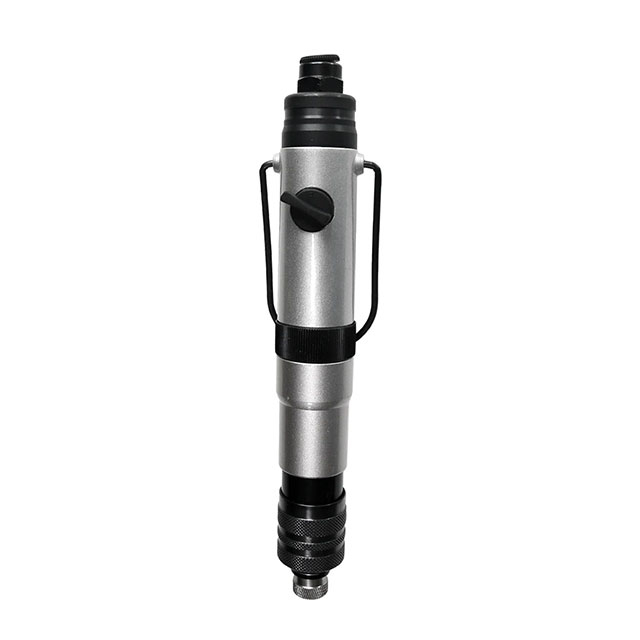
Inline tools align the grip with the tool's driving axis.
They are frequently used in vertically oriented fastening operations and fixture-supported workstations.
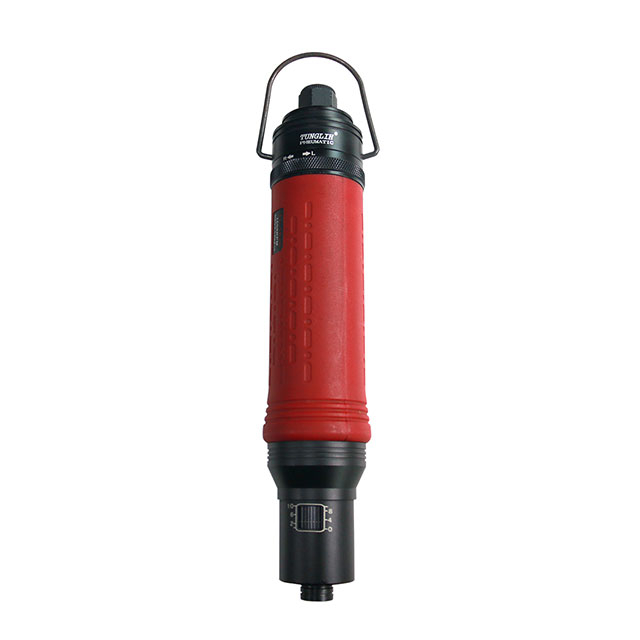
TUNGLIH offers inline pneumatic screwdrivers with different start mechanisms and adjustable torque options.
Shut-off models stop driving when their clutch mechanism reaches the configured torque condition.
This can reduce unnecessary operation after tightening.
The actual tightening result still depends on the joint and operating conditions.
Explore TUNGLIH's shut-off pneumatic screwdrivers for precision assembly applications.
Pistol-grip tools may provide more convenient handling for horizontal fastening.
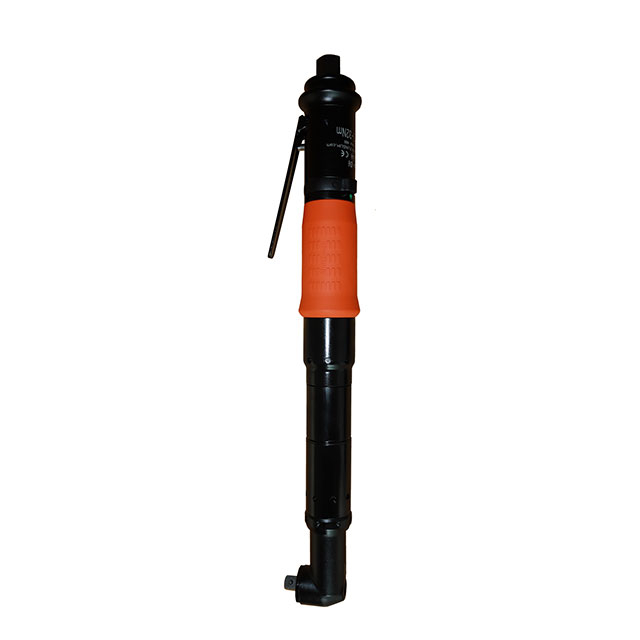
Angle-head configurations can improve access where direct tool alignment is difficult.
Tool orientation should be matched to the operator's posture and the physical layout of the assembly.
Continuous production requires coordination between the tool, air system, maintenance program, and workstation.
Compressed air may contain moisture, particles, and lubricant residues.
Appropriate filtration, drying, and lubrication—where specified by the manufacturer—help protect internal tool components.
Pressure should be measured under operating conditions, not only when the tool is idle.
The U.S. Department of Energy's compressed air guidance recommends reducing unnecessary pressure and improving air system maintenance to control energy use.
Maintenance requirements depend on tool construction and use.
Typical checks include hose condition, fittings, clutch operation, bit wear, and abnormal noise.
The maintenance schedule should follow manufacturer instructions and actual operating frequency.
Manufacturers can track fastening cycle time, rejected assemblies, unexpected tool stoppages, and maintenance events.
These indicators provide a more complete view of tool performance than maximum RPM alone.
Industrial pneumatic tools are used in manufacturing environments that require repetitive fastening and assembly.
Automotive subassemblies may require repeated fastening operations across brackets, interior components, and mechanical assemblies.
Appropriate torque control and process verification are important.
Appliance production lines often involve repeated screws across housings, panels, brackets, and internal components.
Pneumatic screwdrivers can support these operations when their torque ranges match the fastening requirements.
Machinery, metal components, and other assembled products may require different tool geometries and operating conditions.
The workstation should be designed around the actual joint rather than tool specifications alone.
TUNGLIH develops industrial pneumatic screwdrivers for manufacturing and assembly applications.
Its product range includes inline, pistol-grip, clutch-type, and automatic shut-off configurations.
The company also offers OEM/ODM support and accessory options for industrial tool integration.
Browse the TUNGLIH industrial pneumatic tool range to explore available tool designs.
For project discussions, provide required torque, screw size, operating pressure, fastening orientation, and expected production volume.
They can support repeated production cycles, but allowable operation depends on the specific model, air supply, and maintenance requirements.
Not necessarily. Excessive or unstable pressure can change tool behavior and may exceed the manufacturer's specified conditions.
Yes, when their torque range, operating requirements, and tool design are appropriate for the production process.
Torque characteristics, pressure stability, air consumption, cycle time, maintenance, and workstation design all contribute.
Industrial pneumatic tools can support efficient continuous production when tool performance and factory operating conditions are properly coordinated.
TUNGLIH provides pneumatic screwdriver configurations for repetitive industrial fastening applications, helping manufacturers develop suitable assembly tool solutions.