T: +86-13302905061
E: sales@dongli2006.com
E: sales@dongli2006.com
Building 101, No.5 Rixing Street, Pingdong Community, Pingdi Street, Longgang District, Shenzhen, Guangdong, China.
Views: 0 Author: Site Editor Publish Time: 2026-06-05 Origin: Site


Looking for the perfect pneumatic screwdriver? Choosing the right one is crucial for industrial assembly success.
Pneumatic screwdrivers power fast, precise fastening in many industries. But selecting the wrong tool can cause costly errors.
In this post, you’ll learn about key factors influencing performance and how to pick the best pneumatic screwdriver for your needs.
Table of Contents
Torque is the twisting force a pneumatic screwdriver applies to a fastener. It’s measured in units like inch-pounds (in-lbs), foot-pounds (ft-lbs), or newton-meters (Nm). For example, 12 in-lbs means the tool applies a force that would turn a fastener 12 pounds-force at a distance of one inch from the pivot point. Knowing the right unit helps you match the tool to your assembly needs.
To find the torque you need, check the fastener specs or assembly instructions. If unavailable, calculate based on screw size, material hardness, and joint type. For instance, a small screw into plastic requires less torque than a large screw into metal. Testing with a torque meter can confirm the exact torque needed to avoid under- or over-tightening.
Choose a screwdriver whose torque range fully covers your target torque. Tools offer different clutch springs or settings to adjust torque ranges. For example, if your target torque is 20 in-lbs, pick a tool with a range like 10 to 30 in-lbs, not one with 18 to 22 in-lbs. This ensures the tool performs reliably and avoids premature wear.
The best results come when your target torque sits near the middle of the tool’s torque range. This positioning keeps clutch springs balanced and consistent during operation. If the target torque is too close to the upper or lower limit, the tool may not shut off accurately, leading to inconsistent torque and possible damage.
Using a tool near its torque limits causes problems:
Clutch may slip or fail to disengage properly
Torque repeatability drops, increasing variation between fasteners
Risk of over-tightening or under-tightening fasteners
Reduced tool lifespan due to stress on clutch components
This can lead to assembly defects, product failures, or costly rework.
Tip: Always select a pneumatic screwdriver with a torque range that places your target torque near the middle to ensure accuracy, tool longevity, and consistent assembly quality.

Pneumatic screwdrivers come mainly in two shapes: pistol grip and inline. A pistol grip tool looks like a handgun, with the handle perpendicular to the bit. Inline tools have a straight, elongated body where the handle and bit align. Each shape serves different assembly needs.
Pistol grip screwdrivers are designed for applications where the fastener is positioned horizontally or in front of the operator. They offer a natural wrist and arm posture, reducing strain when driving screws straight ahead. Inline tools suit tasks where the fastener faces up or down, such as on a flat bench. The operator holds the tool like a pen, pushing straight down on the fastener.
Ergonomics play a big role in reducing fatigue and injury during repetitive assembly tasks. A tool that fits comfortably in the hand and allows a natural wrist position helps operators work longer and more accurately.
Pistol grip tools reduce wrist twisting when accessing fasteners at waist or chest height. Inline tools minimize arm elevation when working on parts laid flat. Both styles benefit from balanced weight distribution to prevent arm strain.
Handle design, trigger placement, and tool weight affect comfort. Lightweight materials and rubber grips improve control and reduce vibration. Operators should be able to operate the tool without excessive force or awkward body positions.
Use a pistol grip screwdriver when:
Fasteners face horizontally or at waist level
Operator stands or sits facing the part
Wrist twisting must be minimized
Access to confined spaces requires angled approach
Use an inline screwdriver when:
Fasteners face vertically, up or down
Parts lie flat on a bench or conveyor
Tool can be suspended from above
Operator needs a top-down driving motion
For example, assembling furniture with screws on the side panels suits pistol grip tools. Installing fasteners on a flat metal chassis is easier with inline screwdrivers.
Inline pneumatic screwdrivers often pair with tool balancers—spring-loaded retractors that suspend the tool from above. Balancers reduce the tool’s effective weight, easing operator effort and improving control.
Balancers also prevent tools from dropping or dragging cables. This setup is ideal for assembly lines where operators work on large flat parts for extended periods. It helps maintain consistent torque application and reduces fatigue.
Tip: Choose pistol grip screwdrivers for horizontal fasteners and inline tools for vertical fasteners; use tool balancers with inline tools to enhance ergonomics and reduce operator strain.
Pneumatic screwdrivers show an inverse relationship between speed and torque. Tools designed for low torque usually spin faster, while high torque models rotate slower. This gearing balance ensures the tool delivers enough twisting force without sacrificing control. For example, a screwdriver with a torque range of 2 to 20 in-lbs might spin at 2,000 RPM, while one with 50 to 150 in-lbs spins closer to 1,000 RPM.
Selecting the right speed depends largely on the materials and screws used. Hard materials like metals and large screws tolerate higher speeds because the fasteners resist stripping or damage. Soft materials such as plastics, wood, or painted surfaces require slower speeds to avoid damaging the screw or workpiece. Small screws also benefit from slower speeds to maintain accuracy and prevent cross-threading.
Using a high-speed screwdriver on delicate materials risks several problems:
Screws may strip or cam out
Fasteners can walk off the intended spot, causing misalignment
Surface finishes might get scratched or dented
Over-tightening can occur before the operator reacts
These issues lead to poor assembly quality, increased rework, and wasted materials.
The goal is to find a speed that balances fast production with consistent quality. Too slow, and cycle times drag; too fast, and errors rise. Consider the following:
For high-volume metal assembly, a faster tool with moderate torque works well
For mixed materials or delicate parts, a slower, torque-precise screwdriver reduces rejects
Adjustable speed tools or variable air pressure can help optimize performance
Operator skill and training also impact how well speed and torque are managed
By matching speed and torque to the assembly needs, manufacturers improve throughput without sacrificing product integrity.
Tip: Choose a pneumatic screwdriver speed suited to your materials and screw sizes—slower speeds for delicate or soft materials prevent damage and improve assembly accuracy.
Inline pneumatic screwdrivers offer several activation methods tailored for different assembly needs. The most common are:
Push to start: The tool activates when the operator presses the bit against the fastener, applying downward or forward pressure. This method allows quick starts without extra hand movements.
Lever start: The tool only runs when the operator squeezes a lever on the body. This gives more control over when the tool spins.
Combined push to start + lever start: Requires both pressing the bit and squeezing the lever simultaneously. This dual action ensures deliberate tool engagement, reducing accidental starts.
Each activation type balances ease of use and control differently. Push to start is fast but can lead to wandering or misalignment. Lever start offers precision but may slow down the process. Combined activation suits critical assemblies needing both speed and accuracy.
Pistol grip pneumatic screwdrivers also provide multiple activation choices:
Push to start: Similar to inline tools, the screwdriver activates when pressure is applied on the bit.
Trigger start: The operator controls the tool by pulling a trigger on the handle. This mimics a typical power tool feel.
Combined push to start + trigger start: Both pressure on the bit and trigger pull are needed to run the tool.
Trigger start gives operators fine control over tool engagement, reducing accidental starts and improving screw alignment. Push to start is simpler but may cause wandering screws. The combined method adds safety and precision but requires more operator coordination.
Choosing the right activation method depends on the assembly environment and operator preferences:
High volume, less critical assemblies: Push to start tools speed up work, letting operators drive screws quickly.
Precision assemblies: Lever or trigger start tools reduce risk of cross-threading by requiring deliberate tool engagement.
Operator comfort: Some operators find trigger or lever start less tiring because they control the tool intentionally, avoiding accidental starts.
Workpiece orientation: Inline tools with push to start suit flat surfaces; pistol grip with trigger start works well for fasteners facing horizontally.
Testing different activation types during pilot runs helps identify the best fit for your team and product.
Activation method affects how well screws align and fasten:
Push to start: The tool may start rotating before the screw is perfectly seated, causing the screw to "walk" or misalign.
Lever or trigger start: Operators can position the screw head precisely before activating the tool, improving alignment and reducing damage.
Combined activation: Offers the best control, minimizing screw wandering and cross-threading in delicate assemblies.
For critical joints, using lever or trigger start activation enhances quality by ensuring screws start driving only when properly positioned.
Tip: For critical assemblies, choose lever or trigger start activation to improve screw alignment and prevent cross-threading; use push to start for faster, less sensitive applications.
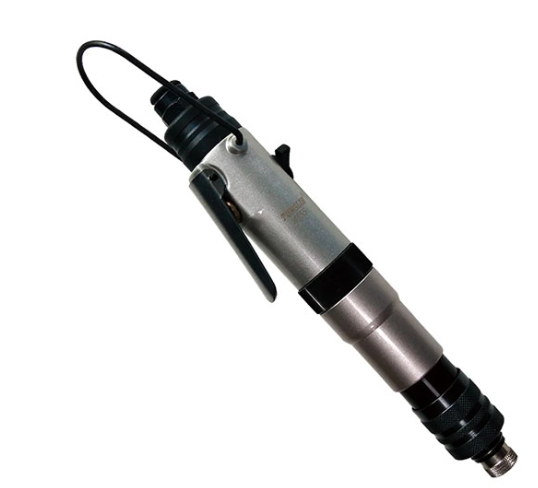
Most pneumatic screwdrivers use a 1/4" female quick change bit holder. This is the standard "chuck" that accepts 1/4" hex shank bits, often called power bits. The bit holder usually has a spring-loaded mechanism and a knurled sleeve. You slide the sleeve forward, insert the bit, then release the sleeve to lock the bit in place. This system makes swapping bits fast and easy, saving time during assembly.
These bit holders are compatible with a wide range of bits for different screw types and sizes. They work well for general industrial assembly tasks, allowing operators to quickly change between Phillips, slotted, Torx, or hex bits as needed. The 1/4" quick change holder is also widely supported by bit manufacturers, so replacement bits are easy to find.
Right angle pneumatic screwdrivers, sometimes called nut runners, often use a 1/4" square drive bit holder instead of the standard 1/4" female quick change type. This square drive fits 1/4" sockets rather than bits. It’s designed for applications where hex or nut-shaped fasteners require tightening.
These square drive holders provide secure socket attachment, reducing the chance of slipping during high-torque applications. They are common in automotive assembly, machinery repair, and other industrial uses where nuts and bolts are fastened rather than screws.
Quick change bit holders bring several benefits for industrial assembly:
Speed: Operators can swap bits or sockets rapidly without tools, reducing downtime.
Flexibility: Easily switch between different screw types and sizes for varied assembly tasks.
Consistency: Secure bit retention minimizes wobble, improving torque accuracy and screw alignment.
Reduced Wear: Quick change holders prevent damage to bits and tools by ensuring proper seating.
Ergonomics: Less time fiddling with bits means less operator fatigue and higher productivity.
These advantages make quick change bit holders the preferred choice in high-volume, precision assembly environments.
Selecting the appropriate bit holder depends on your application:
For general screwdriving involving various screw heads, the standard 1/4" female quick change bit holder is usually best.
If your assembly involves nuts, bolts, or fasteners requiring sockets, especially in tight spaces, opt for a 1/4" square drive bit holder on a right angle screwdriver.
Consider the bit holder’s durability and ease of use for your operators to maintain productivity.
Match the bit holder style to your tooling setup and bit inventory to streamline operations.
When in doubt, consult your pneumatic screwdriver supplier or an assembly tools expert to ensure the bit holder matches your fastening requirements.
Tip: Use standard 1/4" female quick change bit holders for versatile screwdriving and 1/4" square drive holders on right angle tools for socket applications to maximize efficiency and precision in your assembly line.
Choosing the right mechanical clutch depends largely on the hardness of the joint and material you’re working with. Different clutch types control torque delivery differently, affecting precision and tool life. Softer materials or delicate assemblies usually need a clutch that prevents over-torqueing. Harder joints might require a clutch that withstands higher torque or allows more operator control. Matching clutch type to your application ensures consistent fastening quality and reduces rework.
The precision shut off clutch is the most popular for industrial assembly requiring high accuracy. It automatically stops the screwdriver once the preset torque is reached. This clutch delivers repeatable torque within about 10% to 20% variation, depending on the tool. It’s pre-calibrated on a torque meter before production and usually not adjusted at the workstation.
This clutch suits high-volume, critical assemblies like electronics, automotive components, medical devices, and some wood products. Its main benefit is preventing over-tightening while maintaining consistent torque application, which improves joint quality and reduces scrap.
The cushion or ratcheting clutch is common in commercial power tools and some industrial screwdrivers. It produces a distinct ratcheting sound when the torque limit is reached, signaling the operator to stop. Unlike precision clutches, it’s less exact but still reliable for many applications.
This clutch works well for non-critical joints needing consistent torque but not ultra-high precision. It’s ideal for hard or semi-hard materials in general manufacturing, such as toys, appliances, power tools, and lawn equipment. The cushion clutch provides a balance of durability and reasonable accuracy.
Positive jaw clutches are designed for thread cutting or self-tapping screws, where more driving torque than final torque is required. Two opposing jaws engage to rotate the bit. When torque exceeds motor power, jaws separate, stopping rotation. Operators can apply extra forward pressure to re-engage and add torque.
This clutch is less about precision and more about power and control. It’s best for furniture manufacturing, sheet metal work, or applications needing thread cutting. Because of its design, it often comes in higher torque ranges. Skilled operators are needed to avoid overtightening.
Stall tools have no clutch; the motor shaft connects directly to the output. Torque control comes from regulating air pressure. When the fastener’s resistance exceeds motor power, the tool stalls and stops turning.
These tools are compact, lightweight, and rugged, with fewer parts to maintain. They excel in soft materials like wood or sheet metal screws. However, without a clutch, torque precision depends heavily on operator skill and air pressure settings. Stall tools suit non-critical joints where exact torque isn’t mandatory.
Clutch choice directly impacts torque accuracy, repeatability, and joint integrity. Precision clutches offer tight control, improving product quality and reducing defects. Cushion clutches balance durability and accuracy for general use. Positive jaw clutches provide power for tough tasks but require experienced operators. Stall tools favor simplicity and speed but risk inconsistent torque.
Selecting the proper clutch ensures your assembly process meets quality standards while protecting tools and operators. It also reduces scrap, rework, and warranty claims.
Tip: Match clutch type to your joint material and torque needs—use precision clutches for critical assemblies, cushion clutches for general tasks, positive jaw clutches for thread cutting, and stall tools for simple, non-critical fastening.
Always pick a pneumatic screwdriver that covers your target torque comfortably. Your target torque should sit near the middle of the tool’s torque range. This balance ensures the clutch operates smoothly and the tool shuts off consistently at the right torque. Avoid tools with torque limits too close to your target, as they risk slipping or inconsistent fastening. For example, if your assembly requires 30 in-lbs, choose a tool with a range like 15 to 45 in-lbs rather than 28 to 32 in-lbs.
Ergonomics matter for operators working long shifts. Choose a tool shape—pistol grip or inline—that suits the assembly posture and fastener orientation. Look for lightweight tools with comfortable grips and balanced weight distribution. Features like rubberized handles reduce vibration and increase control. If operators must hold the tool overhead or in awkward positions, consider tool balancers or suspension systems to reduce fatigue. A well-designed tool helps prevent repetitive strain injuries and boosts productivity.
Match the tool speed to your materials and screw sizes. High-speed tools work well for metal joints and larger screws, speeding up production. For delicate or soft materials, slower speeds reduce risk of screw stripping or part damage. If your production line demands quick cycle times, consider adjustable speed tools or air regulators to fine-tune performance. Balancing speed and torque helps maintain quality while meeting throughput targets.
Choose the clutch type based on joint hardness and precision needs:
Precision shut off clutch: Best for critical assemblies needing consistent torque and minimal variation.
Cushion or ratcheting clutch: Good for general manufacturing with moderate accuracy demands.
Positive jaw clutch: Ideal for thread cutting or self-tapping screws requiring extra driving torque.
Stall tools (direct drive): Suitable for soft materials or non-critical joints where exact torque isn’t essential.
Selecting the right clutch protects your fasteners, parts, and tools from damage, ensuring assembly quality and reducing rework.
Don’t hesitate to consult tooling experts or suppliers. They can recommend the best tool model, clutch, and bit holder for your specific application. Use torque calibration equipment to verify your tool’s accuracy regularly. Calibration ensures your pneumatic screwdriver delivers repeatable torque and maintains assembly quality over time. Training operators on proper tool use and maintenance also improves results and tool lifespan.
Tip: Choose a pneumatic screwdriver with a torque range centered on your target torque, ergonomic design suited to your operators, appropriate speed for your materials, and the clutch type matching your application to maximize assembly quality and efficiency.
Choosing the right pneumatic screwdriver involves matching torque range, ergonomic design, speed, and clutch type to your assembly needs. Proper tool selection improves efficiency and ensures consistent product quality. Assess your specific industrial requirements carefully to find the best fit. For expert guidance and high-quality tools, rely on Dongli Industrial Equipment (Shenzhen) Co., Ltd., which offers durable, precise pneumatic screwdrivers designed to maximize assembly performance and operator comfort.
A: A pneumatic screwdriver is a tool powered by compressed air that applies controlled torque to fasteners, making industrial assembly efficient and precise.
A: Select a pneumatic screwdriver with a torque range that centers your target torque to ensure accuracy and prevent tool wear.
A: Ergonomics reduce operator fatigue and injury, improving comfort and productivity during repetitive assembly tasks.
A: Common methods include push to start, lever or trigger start, and combined activation, each balancing speed and precision differently.
A: Clutch type determines torque control and suitability for materials—precision clutches for accuracy, cushion clutches for general use, and positive jaw clutches for thread cutting.