T: +86-13302905061
E: sales@dongli2006.com
E: sales@dongli2006.com
Building 101, No.5 Rixing Street, Pingdong Community, Pingdi Street, Longgang District, Shenzhen, Guangdong, China.
Views: 0 Author: Site Editor Publish Time: 2026-07-31 Origin: Site


Electronics manufacturing faces a constant tension between extreme device miniaturization and the demand for high-speed, high-yield production lines. As printed circuit boards shrink and component densities increase, assembly tolerances leave zero margin for error. Suboptimal assembly processes introduce hidden production penalties. Minor fastening failures, such as cross-threading, over-torquing, and particulate contamination, directly lead to product liability issues, extensive rework, and bottlenecked cycle times. Selecting the right approach requires a rigorous evaluation of component types, automation capabilities, torque control mechanisms, and material compliance. Engineers must analyze these variables to ensure scalable, defect-free assembly operations. Implementing a reliable Screw Fastening strategy prevents microscopic debris from causing short circuits and ensures long-term joint integrity in fragile electronic housings.
Component Consolidation: Utilizing pre-assembled solutions (like captive washers) or multi-functional fasteners reduces handling steps and mitigates the risk of loose hardware in sensitive electronic housings.
Automation ROI: Transitioning to automated screw feed and drive systems is justified primarily by decreased cycle times, repeatable torque accuracy, and comprehensive data traceability, rather than just labor reduction.
Material & Footprint Constraints: The shift toward micro-fasteners and alternative materials (e.g., engineered plastics, nylon) requires strict evaluation of load distribution, vibration resistance, and Electrostatic Discharge (ESD) compliance.
Risk Mitigation: Successful implementation hinges on addressing common failure modes upfront, specifically feeder jams in automation and cam-out/cross-threading in precision components.
Table of Contents
Modern electronics assembly demands strict adherence to engineering parameters tailored for micro-fastening applications. Fastener sizes ranging from M1.0 to M3.0 dominate this space. Reduced printed circuit board real estate dictates specific fastener head styles, drive types, and minimal clearance requirements. Engineers must select low-profile heads and precision drive recesses to prevent tool interference with adjacent surface-mount components. When working on the line, you quickly realize that a fraction of a millimeter in head diameter determines whether a driver bit clears a capacitor or crushes it.
Managing cycle times and throughput requires establishing clear baseline metrics for assembly speed. The handling, orientation, and driving phases all contribute to the overall takt time. Manual handling of micro-fasteners significantly slows down production. Optimizing the orientation and delivery of these components directly reduces the seconds required per joint, increasing overall line throughput. We track every second on the floor. A manual operator fumbling with an M1.2 screw adds three seconds per joint. Across a board with twenty joints, that delay destroys daily production targets.
Product liability and yield rates frame the true cost of assembly failure. Precise fastening prevents printed circuit board stress fractures caused by uneven load distribution. Proper seating ensures grounding continuity across metal chassis components. Furthermore, controlled driving eliminates foreign object debris. Metal shavings generated by stripped threads or cam-out can easily bridge microscopic traces, causing catastrophic short circuits in the final product. I have seen entire batches of smartphones scrapped because a single stripped screw head dropped a microscopic metal flake across a power rail.
To establish a baseline for success, engineering teams must evaluate several physical parameters before selecting a fastener:
Measure the exact clearance between the tapped hole and the nearest surface-mount component.
Calculate the required clamp load to maintain grounding without cracking the substrate.
Determine the maximum allowable driver bit diameter to avoid collateral damage during rundown.
Assess the substrate material hardness to select the correct thread pitch and forming geometry.
Consumer electronics, including smartphones and wearables, require micro-screws manufactured to exact specifications. These fasteners must secure delicate components without adding unnecessary weight or bulk. Thread pitch and major diameter tolerances must align perfectly with the mating female threads in plastic or metal housings. When you specify an M1.4 screw for a magnesium alloy chassis, the thread engagement must be flawless to prevent stripping during the initial torque phase.
Drive systems play a critical role in micro-fastening success. Torx Plus and precision Phillips drives offer distinct advantages. Torx Plus provides superior torque transfer and high resistance to cam-out, making it highly suitable for high-RPM driving applications. Precision Phillips remains common but requires precise downward force to maintain tool engagement during the rundown phase. On the assembly line, Torx drives consistently outperform Phillips by reducing operator fatigue and virtually eliminating bit slippage.
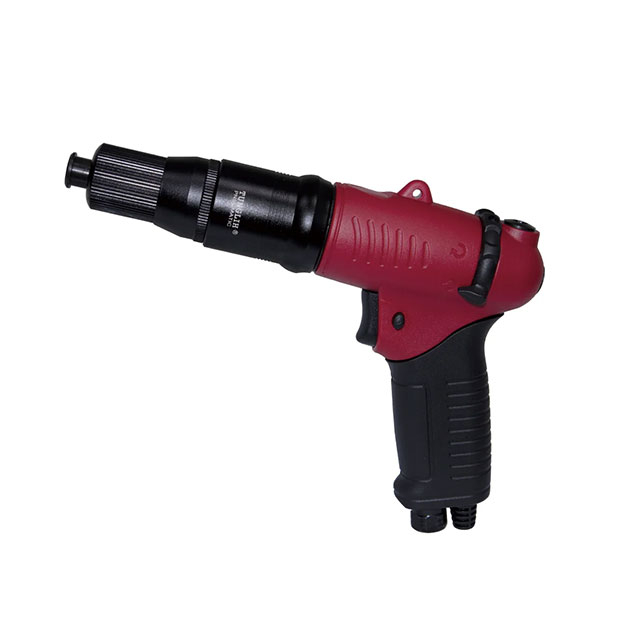
Pre-assembling screws with captive washers or spring sets provides a significant mechanical advantage. These assemblies combine multiple components into a single unit, streamlining the supply chain and the assembly process. The captive washer remains permanently attached to the screw shank, ensuring it is never omitted during production. This guarantees that the engineered load distribution is always applied to the joint.
These components effectively control load distribution on fragile substrates like glass-filled plastics. They improve assembly-line orientation control by providing a consistent center of gravity for automated feeding systems. Most importantly, they eliminate the handling of microscopic loose washers, preventing dropped hardware from contaminating sensitive electronic assemblies. Dropping a 2mm washer into a dense server motherboard usually means pulling the board off the line and shaking it until the part falls out, wasting valuable time.
Modern dual-purpose fasteners combine multiple components to reduce Bill of Materials complexity. Integrated standoffs and spacer-screws act as both the fastening mechanism and the structural support. This consolidation reduces part counts and simplifies inventory management on the production floor. Using a single machined standoff instead of a screw, a separate spacer, and a nut cuts assembly time by two-thirds.
Replacing traditional metal screws with engineered plastics, nylon grommet nuts, or snap rivets offers viability for non-load-bearing applications. These materials provide inherent electrical insulation and significant weight reduction. Plastic knurled head thumb screws allow for tool-less access in specific consumer device compartments. However, engineers must analyze the trade-offs of alternative materials. While they offer weight reduction and insulation, they possess lower tensile strength compared to metal alloys. Engineered plastics also exhibit susceptibility to creep over time when subjected to continuous stress or thermal cycling.
Ultra-thin sheet metal chassis often utilize self-clinching fasteners instead of traditional tapped holes. Self-clinching hardware presses into the metal, displacing material into a specialized annular recess to create a permanent, reusable thread. This contrasts with traditional fastening, which relies on cutting or forming threads directly into the base material. When working with 0.8mm aluminum, you simply cannot tap enough threads to hold a reliable joint, making clinch nuts mandatory.
Hardware-based clinch technology saves space in tight enclosures and provides high push-out and torque-out resistance. However, it requires a secondary pressing operation before final assembly. Dynamic fastening offers immediate joint creation but may require thicker substrate materials to ensure adequate thread engagement and permanent joint strength.
Fastener Type | Primary Advantage | Limitation | Ideal Application |
|---|---|---|---|
Micro-Screws (Torx) | High torque transfer, zero cam-out | Requires precise bit alignment | Smartphones, wearables |
Captive Washer Screws | Eliminates loose hardware handling | Slightly higher unit cost | PCB mounting, fragile substrates |
Nylon Snap Rivets | Tool-less installation, insulating | Low tensile strength, creep | Cable routing, non-structural covers |
Self-Clinching Nuts | Permanent threads in thin metal | Requires secondary press operation | Server chassis, thin enclosures |
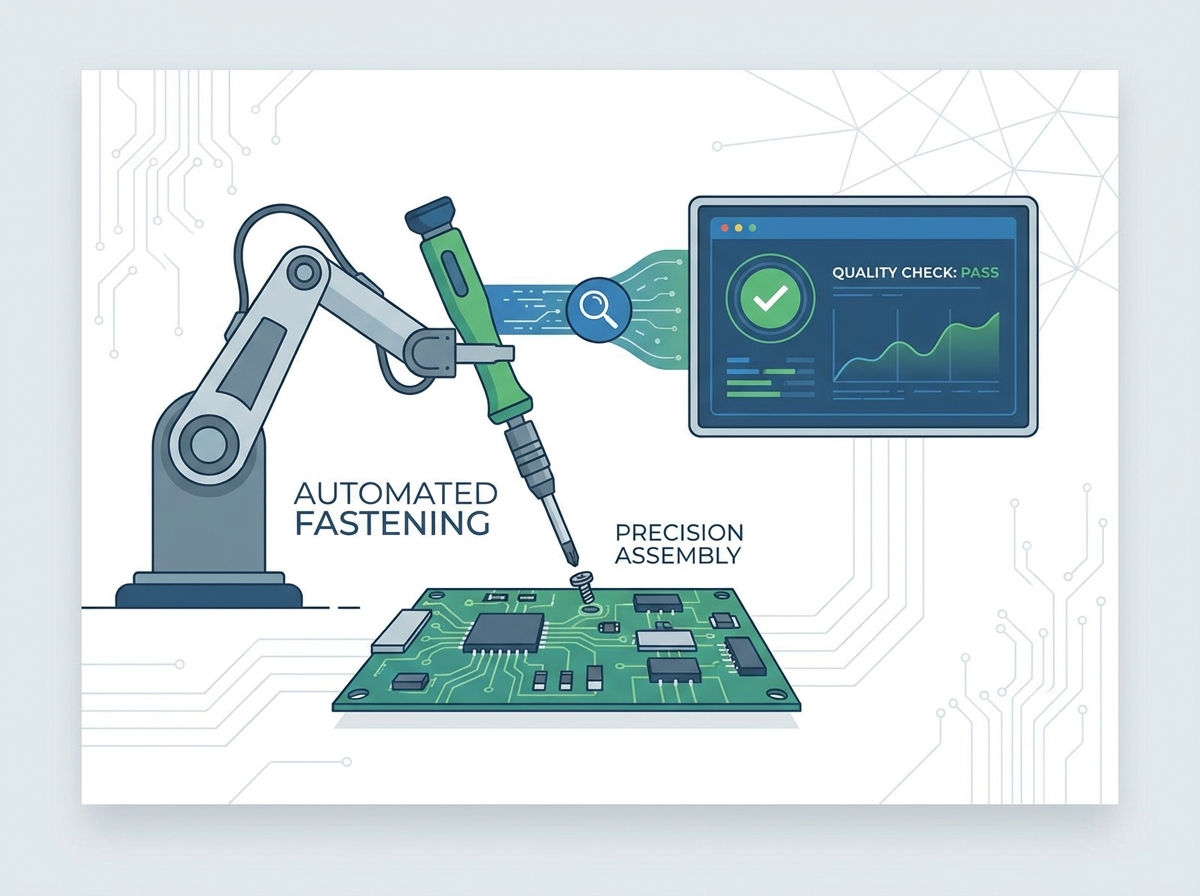
Manual fastening remains optimal for specific manufacturing scenarios. Low-volume production runs, high-mix product lines, and assemblies with complex geometries often benefit from the flexibility of handheld tools. Operators can easily adapt to different fastener types and varied driving angles without requiring extensive reprogramming. When a line runs five different product variants in a single shift, manual drivers provide the necessary agility.
Handheld precision drivers require specific features for electronics manufacturing. Electrostatic discharge-safe housings prevent static buildup from damaging sensitive components. Ergonomic designs reduce operator fatigue during repetitive tasks. Mechanical clutch mechanisms provide baseline torque control, ensuring fasteners reach the required tension without stripping delicate threads. We always specify push-to-start drivers to eliminate trigger fatigue for operators driving hundreds of screws per hour.
Automated feeding relies on blow-feed and step-feeder systems to deliver fasteners directly to the driving tool. Step feeders gently lift screws from a bulk hopper and align them on a linear track. Blow-feed systems use pneumatic pressure to shoot the aligned fastener through a customized tube directly into the driver's jaws. Getting the pneumatic pressure dialed in is critical; too much air pressure will slam the screw into the jaws and damage the threads.
Automated feeding eliminates the manual pick-and-place phase. This drastically reduces cycle times and increases throughput by ensuring the driver is always loaded and ready for the next rundown. Vacuum-assisted driving integrates seamlessly with these systems, holding the fastener securely on the bit for recessed or hard-to-reach fastening points. If you have a deep counterbore, a vacuum sleeve is the only reliable way to guide the screw to the target.
High-volume lines frequently deploy 6-axis robots or SCARA systems equipped with specialized end-effectors. These robotic systems execute highly repeatable driving sequences across multiple coordinates. They provide consistent downward force and precise angle alignment, eliminating human error from the assembly equation. A SCARA robot driving M2 screws into a laptop chassis will hit the exact torque and angle thousands of times a day without variation.
Machine vision plays a critical role in robotic integration. Vision systems compensate for part-to-part tolerance variations in the printed circuit board or chassis. Cameras identify the exact center of the tapped hole, ensuring precise driver-to-screw alignment before the rundown phase begins. Without vision correction, a board shifted by just 0.5mm in the fixture will result in cross-threaded joints across the entire assembly.
Current-control transducerized DC tools offer superior precision compared to mechanical clutch systems. Transducerized tools measure torque and rotation angle in real-time using internal sensors. Mechanical clutches rely on physical springs that wear over time and require frequent calibration to maintain accuracy. On a high-liability line, you cannot trust a mechanical spring; you need digital verification for every single joint.
Capturing seating torque, angle of rotation, and rundown data is essential for quality assurance. This traceability allows manufacturers to verify that every joint meets engineering specifications. If a field failure occurs, engineers can review the exact driving data for that specific serial number to determine root causes. We log the torque curve for every screw. If a screw cross-threads, the system detects the torque spike before the angle requirement is met and immediately flags the part for rework.
Grounding throughout the driving process protects microprocessors and memory chips from static damage. The friction generated during the rundown phase can easily create static charges. All tools, bits, and feeding tubes must feature conductive or dissipative materials to safely route this charge to the ground. You must test the resistance from the driver bit all the way back to the earth ground to ensure it falls within the acceptable megohm range.
Different fastener coatings and driver bit materials impact ESD safety. Standard steel bits may generate higher friction compared to specially coated alternatives. Manufacturers must evaluate the entire material path from the hopper to the final seated position to ensure strict compliance with ESD standards. Using non-compliant plastic tubing on a blow-feeder will generate massive static charges as the screws travel through the line, instantly destroying sensitive components upon contact.
Consumer electronics endure daily drops, impacts, and continuous vibration. Preventing loosening requires specific engineering interventions. Engineers must ensure the joint maintains its clamp load over the entire lifecycle of the device. A loose screw inside a sealed tablet will rattle around and eventually short out the battery management system.
Thread-locking compounds provide chemical resistance to backing out. Specialized thread profiles create mechanical interference with the mating material, resisting vibration without additional chemicals. Mechanical locking washers dig into the substrate, offering high resistance to loosening but potentially damaging the surface of the printed circuit board. We prefer pre-applied micro-encapsulated threadlockers. They remain dormant until the friction of installation bursts the capsules, curing the adhesive exactly when needed.
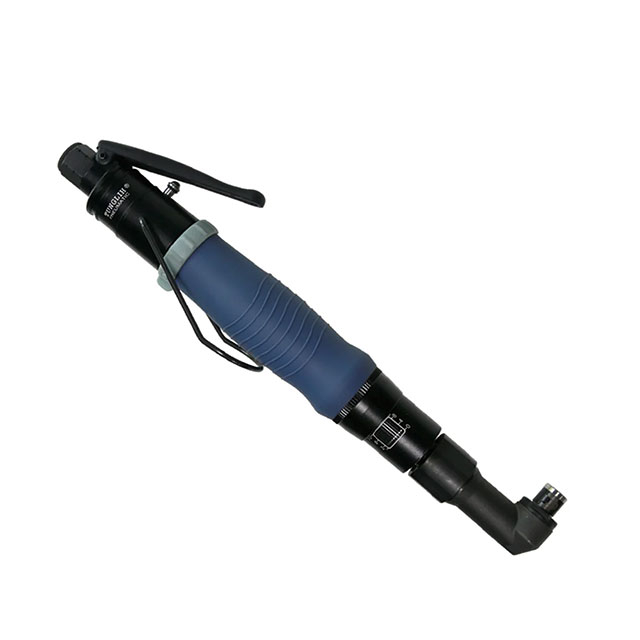
Preventing cross-threading and over-torquing requires specific programming strategies in automated systems. Implementing a reverse rotation before engagement allows the threads to drop into alignment perfectly. Utilizing soft-start RPMs ensures the fastener engages the soft plastics or delicate metals slowly before ramping up to the final driving speed. If you hit a plastic boss at 1000 RPM instantly, you will strip the threads before the screw even seats.
Mitigating feeder jams maintains system uptime. Fastener cleanliness directly impacts hopper performance; oil or debris causes micro-screws to stick together. Dimensional consistency in the fastener batch prevents oversized heads from jamming the linear track. Proper hopper design ensures a steady flow of components without overloading the sorting mechanism. We run all incoming fasteners through a vibratory cleaner to remove manufacturing oils before they ever touch our automated feeders.
Managing component damage requires specialized tooling. Vacuum tubes must feature soft, non-marring tips to prevent scratching adjacent surface-mount components. Specialized bit geometries ensure the tool does not slip out of the drive recess, protecting the surrounding electronic architecture from accidental impact. A standard bit slipping out of a Phillips head will gouge the PCB mask and sever copper traces, ruining a high-value board in a fraction of a second.
To ensure a smooth rollout of a new fastening system, follow these practical steps:
Conduct a full teardown of the product to identify all fastening points and clearance constraints.
Run a capability study on the proposed fasteners using the actual production substrate materials.
Program the driving parameters, including soft-start, rundown speed, and final seating torque.
Validate the ESD grounding path from the tool tip to the facility ground.
Perform a 1000-cycle test run to identify any feeding jams or bit wear issues.
The optimal assembly solution requires a matched system of fastener geometry, driving technology, and torque verification to achieve defect-free production. Selecting the right equipment and hardware directly impacts line throughput and product reliability.
Established in December 2006, Dongli develops, manufactures, and supplies industrial-grade pneumatic and electric tools under the TUNGLIH brand. Supported by an experienced technical team, international certifications, OEM capabilities, and more than 30 parts-production machines, the company provides reliable fastening and automation solutions for electronics assembly and industrial production.
Audit your current assembly line to identify bottlenecks caused by manual fastener handling.
Upgrade to transducerized DC tools for any joints securing high-value or safety-critical components.
Implement pre-assembled captive fasteners to eliminate loose hardware contamination on the PCB.
Program reverse-rotation seating cycles on all automated drivers to eliminate cross-threading in plastic housings.
A: The most reliable method utilizes transducerized DC drivers paired with Torx or specialized micro-drive screws. This combination prevents cam-out, provides real-time torque verification, and ensures precise clamp loads on delicate printed circuit boards.
A: They eliminate the manual pick-and-place phase of assembly. By delivering the fastener directly to the driver bit via pneumatic tubes, the tool is instantly ready for the next rundown, drastically reducing takt time.
A: Captive fasteners reduce handling steps and prevent dropped hardware from causing short circuits. They also provide consistent load distribution across fragile substrates by ensuring the washer is always present and correctly oriented.
A: Transducerized tools use built-in sensors to measure torque and angle in real-time. The system controller monitors this data and shuts off the driver exactly at the target parameter, ensuring repeatable accuracy.
A: Yes, but primarily for low-stress, non-structural applications. While they save weight and offer electrical insulation, plastic fasteners possess lower tensile strength and are susceptible to creep over time.
A: Self-clinching fasteners press into thin sheet metal to provide strong, permanent reusable threads. They are ideal for tight housings where traditional tapped holes are impossible and loose nuts pose a contamination risk.
A: Jams are primarily caused by out-of-tolerance fasteners, debris or oil in the hopper, and incorrect track sizing. Maintaining strict fastener quality control and clean feeding environments prevents system downtime.