T: +86-13302905061
E: sales@dongli2006.com
E: sales@dongli2006.com
Building 101, No.5 Rixing Street, Pingdong Community, Pingdi Street, Longgang District, Shenzhen, Guangdong, China.
Views: 0 Author: Site Editor Publish Time: 2026-07-31 Origin: Site


Manual fastening in precision assembly and electrical work carries hidden financial and safety risks. Relying entirely on operator feel inevitably leads to inconsistent rotational force. Over-tightening causes stripped threads, crushed delicate components, and fractured circuit boards. Under-tightening results in vibration loosening over time, or worse, catastrophic arcing and thermal events in high-voltage electrical panels. Standard hand tools cannot provide the verifiable repeatability required for modern quality audits.
A torque screwdriver solves this core business problem. It is a precision metrology instrument equipped with internal components designed to ensure tightening to a highly specific, predetermined torque. This guarantees the fastening force is sufficient to secure the load permanently, but not excessive enough to damage the fastener or the surrounding materials.
Transitioning from standard hand tools to precision torque instruments eliminates operator variables. It ensures strict compliance with engineering specifications, reduces defect rates, and provides the verifiable fastening data required in high-liability manufacturing and maintenance environments.
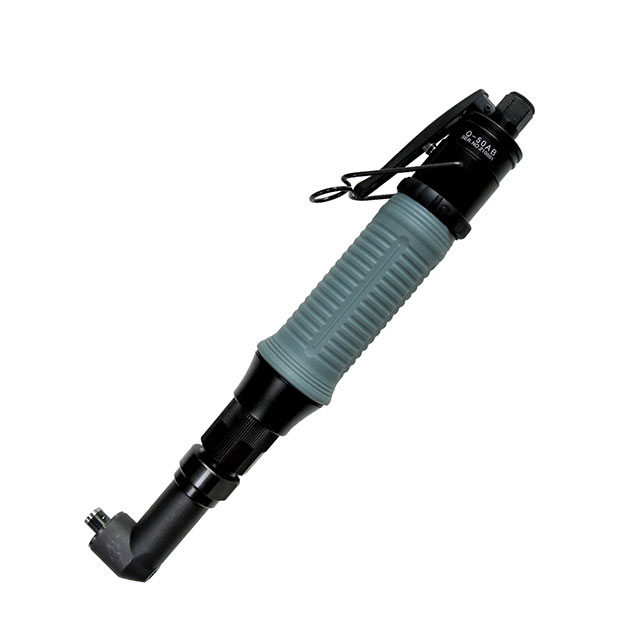
A torque screwdriver utilizes internal clutch mechanisms (such as a radial ball clutch) to apply a specific, controlled level of rotational force, preventing fastener damage.
Selection depends heavily on the production environment: adjustable models offer flexibility for varied tasks, while preset models prevent unauthorized tampering in high-volume assembly lines.
Tool accuracy is highly dependent on the clutch design; "cam-over" or "slip-free" mechanisms physically prevent over-torquing regardless of operator force, whereas "click" types require operator discipline to stop applying force.
Professional electricians ("sparks") and assembly technicians rely on specialized variants (like VDE insulated models) to mitigate high-voltage hazards and meet strict electrical code specifications.
Long-term ROI requires strict adherence to calibration schedules (typically ISO 6789 compliance) and proper storage protocols to maintain spring tension accuracy.
Table of Contents
To understand how this tool protects your assemblies, you must look at the physics of rotational force applied along a longitudinal axis. Torque is simply force multiplied by distance. In a screwdriver, the handle diameter provides the distance, and the operator's hand provides the force. An internal spring-and-clutch system regulates this exact force transfer to the driver bit. When you apply rotational force, the internal components measure the resistance from the fastener against the pre-loaded spring tension.
The engineering behind these tools involves precise metallurgy and machining. The springs used inside are manufactured to exact tolerances, ensuring they compress and release at highly predictable rates. This predictability is what allows a technician to trust the tool when working on sensitive components like aerospace avionics or medical device housings.
Premium industrial tools often rely on a radial ball clutch system. Inside the tool's shaft, precision ball bearings rest inside specific detents (grooves) held in place by spring pressure. The tension on this spring dictates the torque value. As the operator turns the handle, the fastener tightens, and resistance increases. Once the rotational resistance matches the spring tension, the ball bearings are physically forced out of their detents. This action immediately disengages the drive mechanism from the handle.
This mechanical disengagement is instantaneous. The ball bearings ride up and out of their machined pockets, breaking the solid mechanical link between the handle you are turning and the bit driving the screw. This design is highly resistant to wear, provided the tool is kept clean and properly lubricated during its annual calibration and maintenance cycle.
The way the clutch disengages defines the tool's safety profile and operator requirement. Understanding this difference dictates which tool you specify for a given assembly station.
Click Mechanisms: When the target torque is reached, the internal mechanism shifts, emitting a distinct audible click and a tactile bump felt in the handle. The clutch does not completely disengage. The operator must possess the discipline to manually stop turning immediately. If they continue to twist, they will over-torque the fastener. This type is common but requires higher operator training.
Slip or Cam-Over Mechanisms: These are designed for high-liability environments. Once the target torque is achieved, the mechanism completely disengages. The handle spins freely (slips) without transferring any additional force to the fastener. This physically prevents over-torquing, completely removing operator error from the equation.
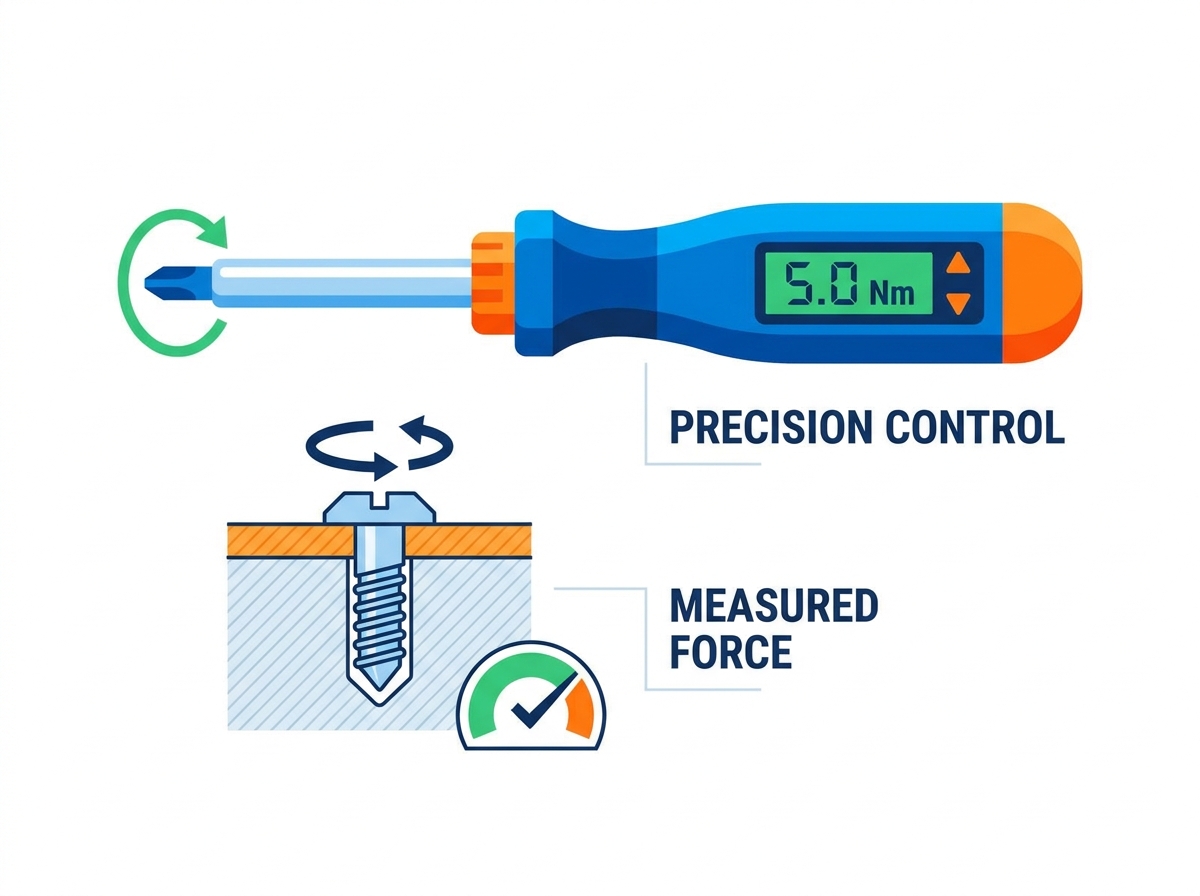
Adjustable models feature an external micrometer scale or a digital interface. This allows the operator to change the torque setting on the fly without needing external testing equipment. They are heavily utilized in maintenance, repair, and overhaul (MRO) environments, custom fabrication shops, and field service operations where technicians encounter multiple different fastener specifications throughout a single shift.
The primary trade-off is the increased risk of operator error. A technician might forget to adjust the scale when moving between different components, applying the wrong torque. They also require more time to adjust and verify between distinct tasks. You will often see these in the tool bags of field service engineers who work on diverse equipment daily.
Preset models lack an external scale entirely. The torque value is adjusted internally using a specialized hex key, and the tool must be connected to a separate torque analyzer to verify the setting. These are built specifically for high-volume manufacturing and assembly lines requiring strict repeatability for a single, specific fastener type.
While inflexible for multi-tasking, preset tools are highly secure against operator tampering. An assembly line worker cannot accidentally or intentionally alter the torque value, ensuring consistent quality control across thousands of cycles. This is the standard choice for electronics manufacturing where a single station drives the exact same screw all day.
Digital and dial screwdrivers provide real-time visual readouts of the exact applied torque. Digital models often include data logging capabilities, storing the peak torque applied to every single fastener. These are essential for quality control auditing, destructive testing, and environments requiring strict data traceability, such as aerospace and medical device manufacturing.
These tools carry a higher initial cost and require battery management. They are also generally more fragile than purely mechanical spring-driven counterparts, requiring careful handling. They are typically reserved for quality assurance inspectors rather than primary assembly line workers.
Electricians working on live panels face unique hazards. VDE insulated models are certified to withstand high voltage, typically up to 1000V AC. They combine precision fastening with critical electrical safety. Precise torque is mandated by electrical codes on breaker panels, switchgear, and EV battery systems to prevent loose connections that lead to localized heating and thermal events.
These tools undergo rigorous testing, including water bath immersion tests and impact tests at freezing temperatures, to ensure the insulation will not fail under field conditions. Using a non-insulated tool in a live panel is a severe safety violation.
Even the most precise metrology tool will fail if used improperly. Following a strict operational protocol ensures accurate fastening and extends the tool's lifespan. Field technicians must build muscle memory around these specific steps.
Pre-Operational Calibration Check: Always verify the calibration sticker before use. Confirm the tool is within its active service cycle and has not been dropped or damaged since its last certification.
Setting the Value: For adjustable models, unlock the collar and align the micrometer scale to the exact target torque. Ensure the locking mechanism is re-engaged before turning any screws.
Fastening Alignment: Seat the driver bit fully into the screw head. Maintain strict coaxial alignment. Keep the tool exactly 90 degrees perpendicular to the fastener axis. Tilting the tool causes cam-out and introduces side-load friction, which skews the actual torque applied to the threads.
The Pull Cycle: Apply smooth, steady rotational force. Jerky or rapid movements cause premature clutch engagement. For click tools, halt rotation the exact millisecond you feel the click. For slip/cam-over tools, continue turning smoothly through the slip-free release to guarantee complete torque delivery.
Post-Operation Zeroing: This is a critical maintenance step. Always return adjustable mechanical spring tensioners to their lowest scale setting before placing them in storage. Leaving the tool under high tension permanently compresses the internal spring, causing rapid calibration drift.
Match the tool's specific range to your application. Mechanical tools are generally most accurate in the middle 80% of their stated range. Avoid buying a tool where your target torque sits at the absolute minimum or maximum of its scale. Understand the standard units required by your engineering drawings, whether that is in-lbs, cNm, or Nm.
Evaluate tools based on ISO 6789 requirements, which typically mandate a tolerance of ±6% for screwdrivers. Tighter tolerances cost significantly more and should be specified only when the joint engineering strictly requires it. Over-specifying accuracy wastes budget, while under-specifying leads to joint failure.
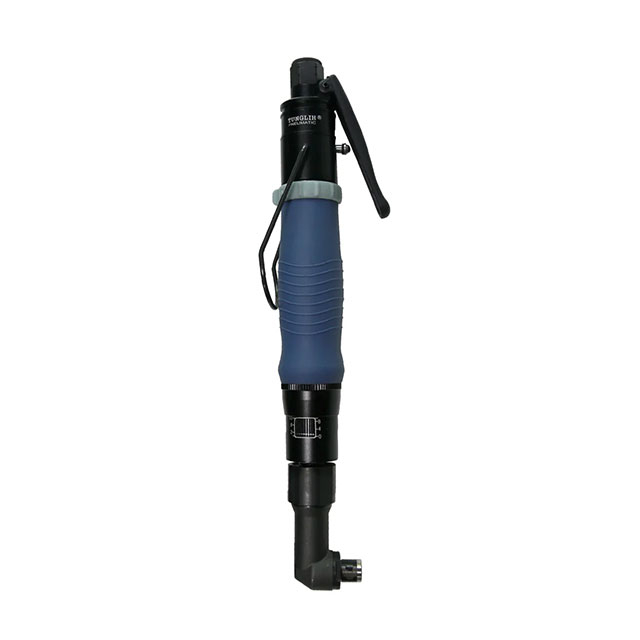
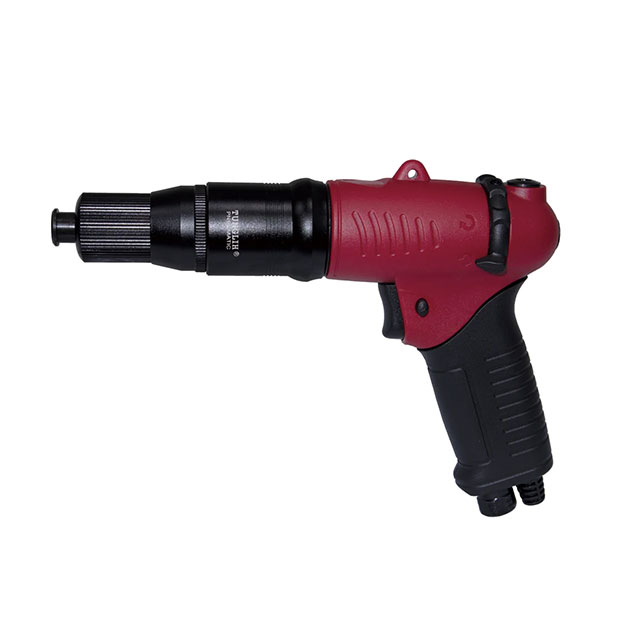
Analyze the handle design based on the application. Inline handles are standard for downward, vertical fastening. Pistol grip designs are better suited for horizontal applications. Prolonged use of poorly designed manual tools leads directly to Repetitive Strain Injury (RSI). Handle materials matter; thermoplastic rubber (TPR) provides better grip with oily hands compared to hard acetate.
In high-volume environments, you must evaluate when to transition from manual tools to pneumatic or electric equivalents to protect worker health and maintain acceptable cycle times. Manual tools are best for low-volume, high-precision work.
Modern manufacturing often requires proof of proper assembly. Evaluate digital screwdrivers that offer wireless data transmission via Bluetooth or Wi-Fi directly to Manufacturing Execution Systems (MES). This data logging fulfills traceability requirements for strict regulatory environments overseen by agencies like the FDA or FAA, providing a digital paper trail for every screw driven on the line.
Selecting the wrong tool category guarantees joint failure. Understanding the mechanical differences between fastening tools is critical for process engineering. You cannot substitute one for the other without compromising the assembly.
Tool Type | Primary Mechanism | Force Application | Best Use Case |
|---|---|---|---|
Torque Screwdriver | Internal spring and clutch (Slip or Click) | Precise, longitudinal, controlled rotational force. | Low-torque precision assembly, electronics, plastics, electrical panels. |
Impact Driver | Rotary hammer and anvil | High-speed, unquantifiable, violent rotational impacts. | Driving long screws into wood, rough construction, non-precision teardowns. |
Torque Wrench | Internal spring lever or digital strain gauge | High-torque, lateral leverage applied perpendicular to the fastener. | Automotive lug nuts, heavy machinery bolts, structural steel connections. |
Contrast the precision and non-destructive nature of a torque screwdriver against the high-speed, highly destructive impacts of an impact driver. Impact drivers cannot be calibrated and should never be used on delicate machine screws. Furthermore, distinguish the screwdriver from a torque wrench. Screwdrivers handle lower-torque, longitudinal drive applications (typically under 40 in-lbs), while wrenches utilize a long handle for lateral leverage on heavy hex nuts and bolts.
Torque tools drift out of specification over time and with heavy use. Using an out-of-calibration tool is worse than using a standard screwdriver because it creates a false sense of security while actively producing defective products. Establish a strict calibration interval. The industry standard is typically every 5,000 cycles or 12 months, whichever comes first. Utilize certified metrology labs or invest in in-house torque analyzers to verify tool accuracy daily or weekly.
Operators transitioning to precision tools require training. Those using "click" style screwdrivers often push past the click, applying excessive force. Alternatively, applying force too rapidly causes the fastener to yield before the clutch engages properly. Implement standardized training focusing on smooth, consistent force application. For critical joints, upgrade to cam-over/slip-free models to remove the operator variable entirely.
The fastest way to destroy an adjustable mechanical torque screwdriver is poor storage. Leaving the tool at a high setting permanently compresses the internal spring, ruining its accuracy and requiring an expensive rebuild. Implement standard operating procedures (SOPs) that strictly require operators to dial the tool back to its lowest setting at the end of every shift. Keep tools in hard cases to prevent physical shock from drops.
A precision fastening instrument is a mandatory metrology tool for risk mitigation, quality assurance, and strict code compliance. Relying on operator feel is a liability you can no longer afford in modern manufacturing or electrical installations.
Base your purchasing decisions on a strict hierarchy of needs. First, identify your required torque range. Second, determine if you need the flexibility of adjustability or the tamper-proofing of a preset tool. Third, choose the appropriate clutch mechanism. Finally, assess your need for digital data logging.
Take the following actions to improve your fastening processes:
Audit your current assembly line to identify joints with high failure rates or stripped threads.
Implement a strict return-to-zero storage policy for all existing adjustable mechanical tools.
Schedule a comprehensive calibration check for all torque instruments currently on the floor.
Consult with a tooling specialist to demo cam-over screwdrivers for your most critical applications.
A: The industry standard, guided by ISO 6789, requires calibration every 5,000 cycles or every 12 months, whichever occurs first. High-volume manufacturing environments may require more frequent verification, often utilizing in-house torque analyzers to check tool accuracy weekly or even daily.
A: Failing to apply the exact specified torque on electrical terminals causes loose connections. These loose connections increase electrical resistance, leading to localized heating, electrical arcing, and potentially catastrophic fires. It also results in immediate failure during electrical code inspections under NEC guidelines.
A: It is generally not recommended unless the tool features a dedicated, locked one-way clutch mechanism designed for loosening. Using a standard precision tool to break away over-tightened or corroded screws can severely damage the internal calibration spring and clutch mechanism.
A: An adjustable screwdriver features an external scale, allowing the operator to change torque settings easily for different tasks. A preset screwdriver has no external scale; the torque is set internally using an analyzer. Preset tools prevent operator tampering in high-volume, single-task assembly lines.
A: For adjustable mechanical models, you must wind the scale down to its lowest marked setting before storage. Leaving the tool at a high torque setting keeps the internal spring under constant compression, leading to permanent spring fatigue and rapid calibration drift.
A: A cam-over, or slip-free, torque screwdriver features a clutch mechanism that completely disengages once the target torque is reached. The handle spins freely, physically preventing the operator from applying any additional rotational force and completely eliminating the risk of over-tightening.