T: +86-13302905061
E: sales@dongli2006.com
E: sales@dongli2006.com
Building 101, No.5 Rixing Street, Pingdong Community, Pingdi Street, Longgang District, Shenzhen, Guangdong, China.
Views: 0 Author: Site Editor Publish Time: 2026-07-31 Origin: Site


In high-volume manufacturing, assembly, and industrial maintenance, the reliability of hand tools directly impacts production uptime and product quality. A failing tool results in stripped fasteners, damaged components, and costly delays. The global tool market is saturated with white-label consumer brands masquerading as industrial-grade suppliers. Procurement teams and tool distributors face the challenge of distinguishing between superficial aesthetic quality and genuine, verifiable metallurgical and manufacturing excellence.
Selecting the right partner requires moving beyond marketing claims to audit their raw material sourcing, machining tolerances, quality assurance protocols, and supply chain stability. This guide provides a technical framework for evaluating and shortlisting industrial tool partners, ensuring you partner with a competent Screwdriver Manufacturer capable of meeting rigorous operational demands on the factory floor.
Metallurgy is Non-Negotiable: A reliable manufacturer must demonstrate transparent sourcing and precise heat treatment of high-grade tool steels (e.g., S2, SVCM, or proprietary alloys) to prevent tip shattering and cam-out.
Profile Precision Minimizes Failure: Exacting adherence to international standards (DIN, ISO, JIS) prevents tool-to-fastener mismatch and catastrophic component damage.
Application-Specific Compliance: Industrial environments require strict adherence to international safety and operational standards, including VDE for electrical insulation and ESD for sensitive electronics.
Scalability and QA: True industrial partners offer verifiable Quality Assurance (QA) data, consistent tolerances across high-volume production runs, and transparent Minimum Order Quantities (MOQs).
Table of Contents
Cam-out occurs when a screwdriver tip slips out of the fastener head during torque application. This mechanical failure damages the screw recess, strips the tool tip, and often scratches surrounding components. Preventing cam-out requires absolute dimensional accuracy. Industrial tools rely on CNC-machined tips rather than cast alternatives. CNC machining guarantees exact engagement with specific screw recesses, whether Phillips, Torx, or Pozidriv. Profile accuracy is paramount. A capable Screwdriver Manufacturer must demonstrate the capacity to produce specialized profiles. For example, the Japanese Industrial Standard (JIS) features a different cross-section than a standard Phillips head. Using a Phillips driver on a JIS screw guarantees stripping. Similarly, Torx Plus requires distinct machining tolerances compared to classic Torx profiles to ensure flawless assembly operations. When auditing a supplier, request their optical comparator reports to verify tip geometry against DIN or ISO blueprints.
The difference between a consumer tool and an industrial tool often comes down to micro-tolerances. A tip that is undersized by even a few thousandths of an inch will wobble in the fastener. This wobble translates to uneven stress distribution across the flutes of the tip. Under high torque, this localized stress causes the steel to shear. We look for manufacturers who maintain tight statistical process control (SPC) on their CNC milling centers, ensuring the first tip off the line is identical to the ten-thousandth.
The biomechanics of torque transfer dictate how effectively a worker can drive a fastener without fatigue. Handle design plays a critical role in reducing Repetitive Strain Injury (RSI) on assembly lines. A poorly designed handle forces the operator to grip harder, accelerating muscle fatigue and joint strain. Handle material profiles vary significantly based on application. Rigid cores, such as cellulose acetate, offer extreme durability and impact resistance but lack comfort for continuous use. Multi-component elastomer soft-grip handles provide superior torque transfer and ergonomics. However, the chosen material must perform reliably in specific environments. Handles used in heavy machinery assembly must resist degradation from oils, while those in chemical plants require specific solvent resistance.
We evaluate handle geometry based on the specific task. A precision electronics screwdriver requires a long, slender handle with a rotating end cap for rapid finger-tip rotation. Conversely, a heavy-duty slotted driver used for prying or high-torque fastening needs a bulbous, triangular, or hexagonal handle to maximize palm contact area and prevent rolling on a workbench. The durometer (hardness) of the overmolded rubber must strike a balance: too soft, and it tears under heavy use; too hard, and it fails to provide adequate grip when hands are covered in cutting fluid or grease.
Industrial applications frequently demand specialized tool properties. Electrostatic Discharge (ESD) safe handles are mandatory in electronics manufacturing to prevent static electricity from destroying sensitive microchips. These handles are manufactured using dissipative plastics that safely bleed off static charges to ground. For high-voltage applications, tools must feature VDE-certified insulation, protecting operators from electrical shock up to specified voltage limits (typically 1000V AC). This insulation isn't just a plastic dip; it requires specialized injection molding over the entire shaft, leaving only the working tip exposed.
Furthermore, chemical and solvent resistance is non-negotiable for handles utilized in automotive, military, or aviation maintenance, where exposure to hydraulic fluids, brake cleaners, and aviation fuels is constant. Standard rubber grips will swell, dissolve, or become dangerously slippery when exposed to Skydrol or MEK. A competent manufacturer will provide material safety data sheets (MSDS) and chemical resistance charts for their handle polymers, proving their suitability for harsh industrial environments.
The foundation of any industrial hand tool is its steel composition. Different alloys offer varying balances of hardness and toughness. You cannot visually inspect steel quality; you must rely on metallurgical data and testing.
Steel Grade | Characteristics | Best Industrial Application |
|---|---|---|
Chrome Vanadium (Cr-V) | Good general-purpose strength, high corrosion resistance. | Standard maintenance, light assembly. |
Chrome Molybdenum (Cr-Mo) | High impact resistance, excellent toughness. | Impact drivers, heavy-duty fastening. |
S2 Tool Steel | Exceptional hardness, superior wear resistance. | High-torque applications, continuous assembly line use. |
SVCM Alloy | Premium blend offering the highest balance of torque and shock resistance. | Precision engineering, aerospace, advanced manufacturing. |
Beyond the raw material, the heat treatment process—encompassing hardening and tempering—is critical. A precise heat treatment protocol achieves the optimal Rockwell Hardness (HRC) rating while maintaining enough toughness to prevent the tip from shattering under sudden torque loads. For example, S2 steel is typically hardened to HRC 58-62. If the tempering process is rushed, the steel remains brittle. If the temperature is too low, the steel is too soft and will round off. We audit the manufacturer's heat treatment facility to ensure they use computer-controlled atmospheric furnaces, which prevent decarburization and ensure uniform hardness throughout the entire batch.
Manufacturing dedicated fixed-shaft screwdrivers involves different complexities compared to interchangeable, multi-bit driver systems. Fixed-shaft tools require a continuous piece of steel anchored deeply into the handle, ensuring zero mechanical play and maximum torque transfer. Interchangeable systems rely on magnetic or mechanical retention mechanisms. While versatile, multi-bit systems introduce potential points of failure, such as bit wobble or retention loss under high-frequency factory use. High-volume manufacturing facilities generally favor fixed-shaft tools for their absolute rigidity and reliability.
In aerospace and defense manufacturing, Foreign Object Debris (FOD) is a critical concern. A loose bit falling into a jet engine turbine or a satellite chassis can cause catastrophic failure. Therefore, these industries strictly mandate fixed-shaft tools. When evaluating a manufacturer for fixed-shaft tools, we examine the runout—the amount of wobble at the tip when the handle is rotated. Excessive runout indicates a bent shaft or a misaligned handle molding process, both of which are unacceptable for precision assembly.
Advanced manufacturing techniques significantly enhance tip durability and grip. Laser etching and micro-roughness texturing create microscopic ridges that bite into the screw head, drastically increasing friction. Diamond coating and titanium nitride (TiN) coating offer extreme wear resistance, extending the tool's operational life. These coatings are not merely cosmetic; they are applied using Physical Vapor Deposition (PVD) processes that bond the coating at a molecular level to the steel substrate.
The structural integrity of the blade-to-handle connection is equally vital. The blade tang must anchor deeply into the handle core to withstand rotational shear. Full tang designs, where the steel extends through the handle and terminates in a striking cap, offer maximum strength for applications requiring light hammering. Hexagonal bolsters at the base of the shaft allow operators to use a wrench for additional leverage without compromising the handle. We look for manufacturers who utilize winged or fluted tangs, which mechanically lock into the plastic core during injection molding, preventing the shaft from spinning inside the handle.
Modern industrial handles utilize dual-material or tri-material overmolding processes, typically combining a rigid Polypropylene (PP) core with a softer Thermoplastic Rubber (TPR) exterior. The manufacturer must ensure a flawless chemical bond between these materials. If the bonding process is flawed, the outer grip will slip, degrade, or detach from the rigid core under maximum torque loads, rendering the tool useless and posing a safety hazard.
We verify this by requesting pull-off force test data. The manufacturer should have specialized equipment that clamps the shaft and attempts to pull the handle off, measuring the force required to cause failure. A high-quality industrial screwdriver will often see the steel shaft break before the handle detaches. Furthermore, the injection molding process must be free of voids or air pockets, which create weak points in the handle structure. X-ray inspection of sample batches can reveal these hidden defects.
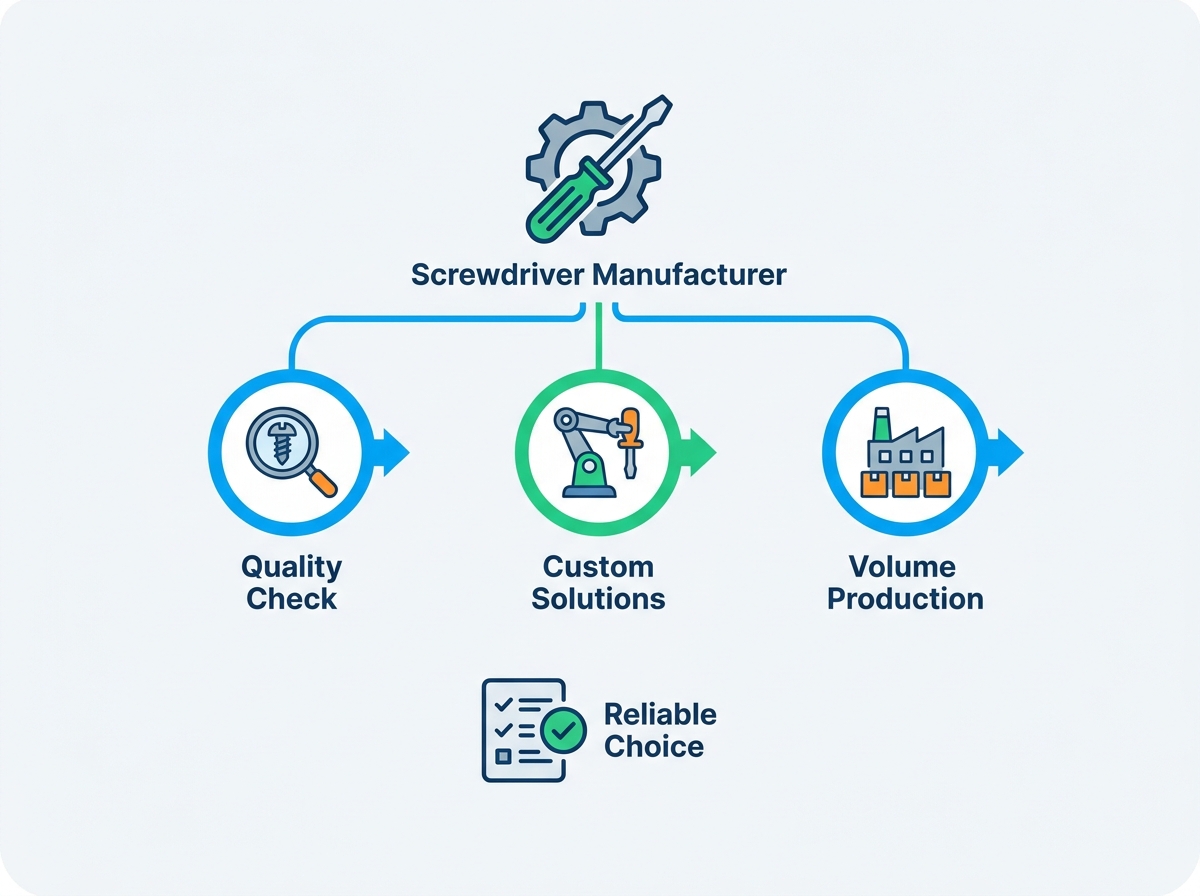
A reliable Screwdriver Manufacturer implements rigorous testing protocols. Torque destruction testing determines the maximum rotational force the tool can withstand before catastrophic failure. Rockwell hardness testing verifies the efficacy of the heat treatment process. Salt spray testing confirms the corrosion resistance of the blade plating. Procurement teams should always request comprehensive batch testing reports and statistical process control (SPC) data to verify consistent quality across massive production runs.
Test Type | Purpose | Standard/Metric |
|---|---|---|
Torque Destruction | Measures maximum rotational force before failure. | DIN ISO 8764 / DIN ISO 2380 |
Rockwell Hardness (HRC) | Verifies heat treatment and steel hardness. | HRC 58-62 (Typical for S2 Steel) |
Salt Spray Test | Evaluates plating and corrosion resistance. | ASTM B117 (e.g., 72 hours at 5% NaCl) |
Dielectric Testing | Ensures insulation integrity for VDE tools. | IEC 60900 (10,000V test for 1,000V rating) |
We do not accept verbal assurances of quality. A true industrial partner maintains an in-house testing laboratory equipped with calibrated torsion testing machines, hardness testers, and environmental chambers. They should be willing to provide video evidence of these tests being performed on your specific production batch. If a supplier outsources all their testing, it introduces delays and raises questions about their internal quality control culture.
Facility certifications provide a baseline for operational maturity. ISO 9001 certification indicates a robust quality management system, while ISO 14001 demonstrates compliance with environmental management standards. Product-specific certifications require third-party verification. Insulated tools must carry IEC 60900 and VDE certifications, proving they have been individually tested to withstand high voltages. Tip geometry must strictly adhere to DIN and ISO standards to guarantee compatibility with global fastener specifications.
When auditing a supplier, verify the scope and validity of their ISO certificates. A certificate covering "sales and distribution" is useless if you are evaluating their manufacturing capability. The certificate must explicitly cover "design and manufacturing of hand tools." For VDE tools, check the VDE institute's online database to ensure the specific tool models are listed, not just the factory itself. Counterfeit VDE markings are common in the lower tiers of the tool market, and using unverified insulated tools exposes your workforce to lethal risks.
Many industrial clients require Original Equipment Manufacturer (OEM) or Original Design Manufacturer (ODM) services. Evaluating these capabilities involves assessing the manufacturer's engineering department. Can they produce custom bit profiles for proprietary fasteners? Do they have the tooling capacity to create custom handle molds tailored to specific ergonomic requirements? Furthermore, their ability to execute private-label branding with permanent, chemical-resistant markings is essential for corporate tool control programs.
We look for manufacturers who utilize laser marking rather than pad printing for logos and part numbers. Pad printing wears off quickly in industrial environments, making tool identification and warranty claims impossible. Laser marking etches the information directly into the steel or plastic, ensuring permanent traceability. Additionally, assess their ability to provide custom packaging solutions, such as EVA foam trays for tool control cabinets, which are standard requirements in aviation and military maintenance facilities.
Tool manufacturing faces several potential bottlenecks, including raw steel shortages and injection molding delays. Evaluating a supplier requires understanding their maximum monthly output and their reliance on secondary raw material markets. To mitigate risks, negotiate guaranteed lead times and establish buffer stock agreements, ensuring your assembly lines never halt due to tool shortages.
We analyze the manufacturer's machine utilization rates. If a factory is running at 95% capacity just to meet current orders, they have zero flexibility to handle a sudden spike in your demand. A reliable partner maintains surge capacity. Furthermore, we investigate their tooling maintenance schedules. Injection molds degrade over time, leading to flash (excess plastic) on handles and dimensional inaccuracies. A proactive manufacturer has an in-house tool and die shop to maintain and rebuild molds before they impact product quality.
Inconsistent steel quality from secondary suppliers leads to unpredictable tool failure. A batch of screwdrivers made from substandard steel will exhibit high rates of tip breakage. Auditing a manufacturer's supply chain for raw material traceability is mandatory. Request mill certificates for the steel used in your production batches to ensure it meets the agreed-upon metallurgical specifications.
The global steel market fluctuates, and lower-tier manufacturers often switch suppliers to chase the lowest price, resulting in inconsistent tool performance. We demand that our manufacturing partners lock in their steel supply from reputable mills and provide documentation proving the chemical composition of every batch. If a manufacturer cannot trace a finished screwdriver back to the specific coil of steel it was cut from, their quality control system is inadequate for industrial demands.
The prototyping and sampling phases reveal the true competence of a manufacturer's engineering support. Assess their responsiveness to design iterations and quality feedback. Clear communication channels, rapid prototyping capabilities (such as 3D printing for handle ergonomics), and a willingness to adjust machining tolerances based on field testing are indicators of a strong, long-term manufacturing partner.
When developing a custom tool, we expect the manufacturer to provide SLA (Stereolithography) 3D printed handle prototypes within days, allowing our assembly workers to test the ergonomics before we commit to expensive steel injection molds. The manufacturer's engineers should be capable of reading and modifying CAD files (STEP, IGES) and providing detailed technical drawings for approval. Language barriers and time zone differences must be managed through dedicated project managers who understand technical tooling terminology.
Established in 2006, Dongli develops, manufactures, and supplies industrial-grade pneumatic and electric tools under the TUNGLIH brand. Supported by an experienced technical team, international certifications, OEM capabilities, and more than 30 machines for parts production, the company provides practical fastening solutions for industrial assembly and maintenance applications.
Draft a comprehensive Request for Proposal (RFP) detailing required steel grades, tip tolerances, and specific compliance standards (e.g., VDE, ESD).
Request physical samples from shortlisted manufacturers and subject them to independent torque destruction and Rockwell hardness testing.
Demand transparency by requiring mill certificates for raw steel and statistical process control (SPC) data for recent production batches.
Conduct a facility audit, either in-person or via a verified third party, to confirm ISO certifications and evaluate injection molding capabilities.
A: S2 tool steel is widely considered the best for its exceptional impact resistance and high hardness, preventing tip wear. SVCM and Cr-Mo are also excellent, strong alternatives depending on the specific torque requirements and whether the tool is subjected to heavy shock loads.
A: JIS (Japanese Industrial Standard) screws feature a shallower recess and sharper corners than standard Phillips screws. Using a standard Phillips driver on a JIS screw leads to immediate cam-out and damage. A top-tier manufacturer must possess the precision machining capability to produce true JIS tips for electronic and automotive assemblies.
A: Fixed-shaft drivers are superior for high-torque applications, absolute precision alignment, and strict safety/VDE compliance. They are also mandatory in environments where loose bits present a severe FOD (Foreign Object Debris) risk, such as aerospace manufacturing.
A: You can verify VDE certification by checking the official VDE institute's online database. It is crucial to ensure that the certification applies directly to the specific tool models you intend to purchase, rather than just being a general facility certification.
A: OEM (Original Equipment Manufacturer) involves producing tools exactly to the buyer's provided design specifications and blueprints. ODM (Original Design Manufacturer) involves the manufacturer providing pre-engineered designs and tooling, which the buyer then selects and brands as their own.
A: These advanced coatings and textures significantly increase the friction between the screwdriver tip and the screw head. This enhanced grip drastically reduces the likelihood of cam-out, protects the fastener from stripping, and extends the overall operational life of the tool.