T: +86-13302905061
E: sales@dongli2006.com
E: sales@dongli2006.com
Building 101, No.5 Rixing Street, Pingdong Community, Pingdi Street, Longgang District, Shenzhen, Guangdong, China.
Views: 0 Author: Site Editor Publish Time: 2026-11-09 Origin: Site


Industrial tool torque accuracy describes how closely a fastening tool's measured or delivered torque agrees with a specified reference or target under defined conditions. Torque repeatability describes how consistently the tool produces similar results during repeated tests.
Both are important for industrial assembly, but they measure different aspects of fastening performance. A tool can produce highly repeatable results while consistently missing the desired target torque.
Table of Contents
Torque accuracy is used to describe the closeness of a measured or delivered torque value to a reference or specified value.
In industrial fastening, the meaning of an accuracy claim must be clearly defined.
It may refer to the accuracy of a built-in measurement system, the deviation of delivered torque from a target, or another manufacturer-defined test result.
Suppose a fastening tool is set to a target torque of 5.0 Nm.
If the measured torque is 5.2 Nm, the deviation from the target is:

The measured result is 4% above the target.
This example illustrates the calculation of deviation. It does not establish the tool's overall accuracy rating or measurement uncertainty.
Incorrect tightening can affect the performance of an assembled joint.
Insufficient torque may result in inadequate clamp load.
Excessive torque can damage threads, fasteners, or surrounding components.
However, torque is only an indirect indicator of clamp load.
Joint friction, material properties, and fastener geometry also influence the relationship.
A tool may perform well on a laboratory test fixture while delivering different results on production joints.
This can occur because joint stiffness and friction change the tightening process.
Engineers should therefore distinguish laboratory tool performance from actual assembly process capability.

Torque repeatability describes the variation between results obtained under specified repeated test conditions.
A repeatable tool produces a relatively narrow spread of results.
Consider five hypothetical measurements from a tool set near 5.0 Nm.
Test | Measured Torque |
|---|---|
1 | 5.1 Nm |
2 | 5.2 Nm |
3 | 5.1 Nm |
4 | 5.2 Nm |
5 | 5.1 Nm |
These measurements show relatively low variation, but all are above the 5.0 Nm target.
The tool could be repeatable without being correctly adjusted.
In repetitive assembly, large variation may lead to different tightening results between products.
The problem may become more significant in automated or high-volume production.
Repeatability testing helps identify whether the tool can produce stable results under controlled conditions.
Several factors can influence torque scatter:
Joint stiffness
Fastener and thread friction
Tool operating speed
Clutch condition
Air pressure or electrical supply
Operator technique
Tool maintenance
Test equipment and setup
To obtain meaningful results, these factors should be controlled or documented during testing.
Comparison | Torque Accuracy | Torque Repeatability |
|---|---|---|
Main Question | How close is the result to the reference? | How consistent are repeated results? |
Primary Focus | Deviation from reference or target | Variation among measurements |
Common Evaluation | Error or deviation under defined conditions | Standard deviation or other scatter measures |
Possible Problem | Consistent over-tightening | Inconsistent tightening |
Corrective Action | Review calibration, settings, or method | Investigate tool, joint, and process variation |
A set of measurements may average close to the target while showing substantial variation.
The average alone can hide the risk of under-tightened and over-tightened assemblies.
A tool may deliver nearly the same torque every time but remain consistently above or below the intended value.
Adjusting the tool may correct the average result, provided the underlying process is stable.
The desired condition is a tool and fastening process that achieve an appropriate mean result with acceptable variation.
Actual acceptance criteria should be based on engineering requirements rather than a universal percentage.
ISO 5393:2017 provides laboratory performance test methods for suitable powered assembly tools used with threaded fasteners.
It addresses torque repeatability across defined torque rates, tool adjustments, and operating cycles.
It also addresses built-in torque measurement system precision for applicable tools.
The standard does not apply to impact or impulse wrenches. Its stated main scope covers continuous-torque tools from 0.5 to 2,000 Nm, with documented modifications possible outside that range.
Review the official ISO 5393:2017 performance testing standard for its scope and requirements.
Torque testing should use suitable measurement equipment.
The test equipment must have appropriate measurement capacity, resolution, and uncertainty for the required torque.
Calibration traceability is important when results are used for formal inspection.
Laboratory tests can characterize tool performance under controlled conditions.
Production verification confirms how the tool performs with actual fasteners, components, and operators.
Both may be needed for critical fastening processes.
A practical verification program should use documented conditions and appropriate measurement equipment.
Establish the required tightening torque and acceptable range from the joint engineering specification.
The tolerance should not be based solely on the screwdriver's advertised precision.
Use an appropriately calibrated torque tester, transducer, and test fixture.
Confirm that the test setup matches the intended verification method.
Conduct a defined series of repeated tests.
Record the individual values instead of only the average.
Review the average torque and the scatter of measured results.
Averages help identify systematic deviation.
Variation helps identify consistency problems.
Where required, verify the fastening process using representative production joints.
Hard and soft joints may produce different results because the torque rise rates differ.
Maintain records of tool identification, operating settings, measurement equipment, test conditions, results, and corrective actions.
This supports ongoing process verification.
Automatic shut-off screwdrivers use a mechanism that stops driving when the configured torque condition is reached.
This can improve repeatability under suitable conditions.
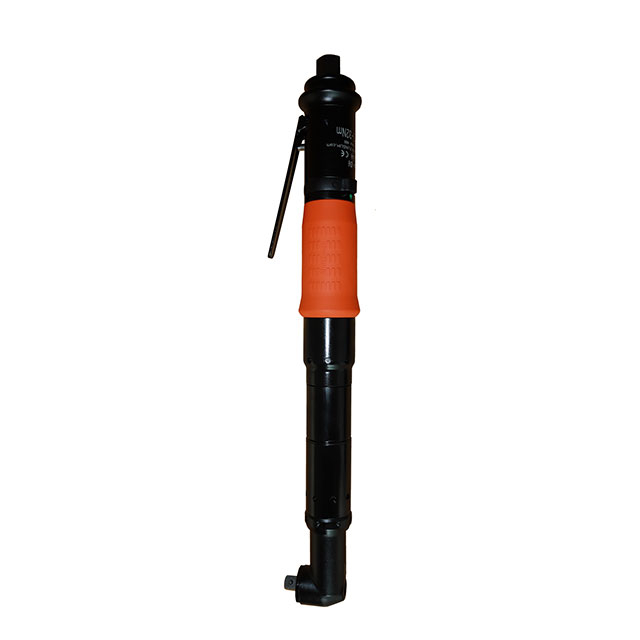
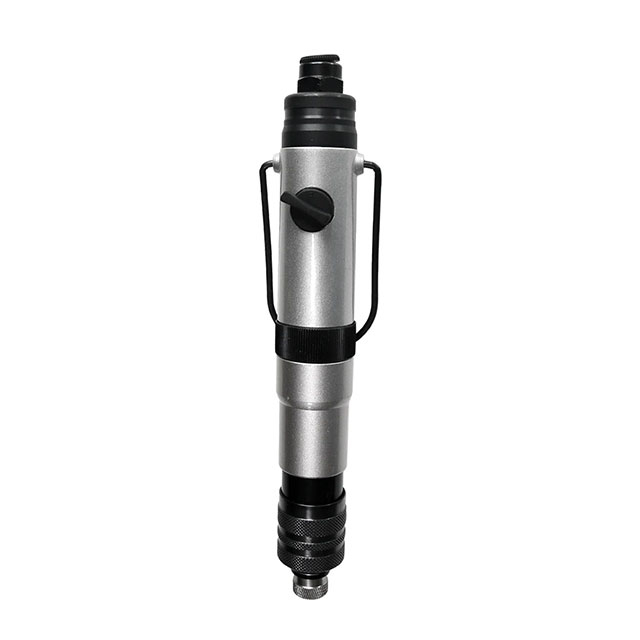
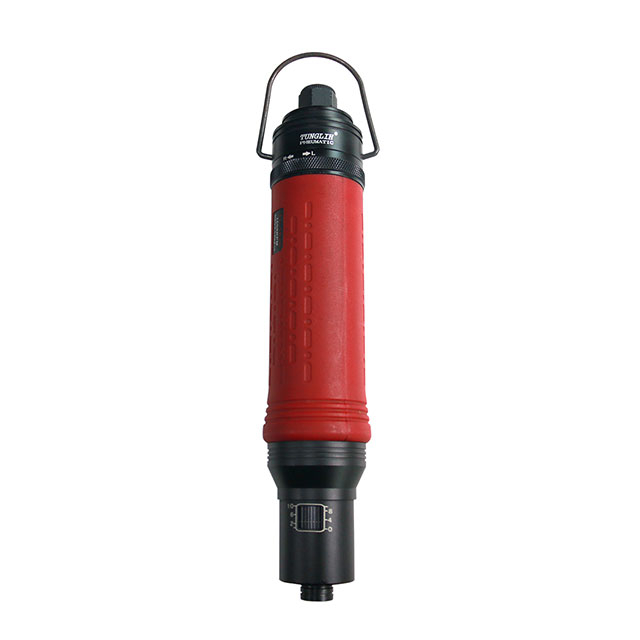
TUNGLIH provides automatic shut-off pneumatic screwdrivers for precision assembly applications.
Electric screwdrivers can use adjustable control mechanisms to regulate fastening performance.
Different models offer different torque ranges, start mechanisms, and control capabilities.
Explore TUNGLIH's torque electric screwdrivers.
Wear in the clutch, transmission, or drive components may affect fastening results.
Tool testing should therefore continue throughout the operating life of the equipment.
For additional background, read How Torque-Control Pneumatic Screwdrivers Improve Assembly Accuracy.
TUNGLIH manufactures pneumatic and electric screwdrivers for industrial fastening applications.
The product range includes precision electric screwdrivers, automatic shut-off pneumatic tools, and adjustable-torque configurations.
For applications requiring controlled tightening, tool selection should be based on fastener size, target torque, joint stiffness, fastening speed, and verification requirements.
No. Accuracy concerns closeness to a reference, while repeatability concerns variation among repeated results.
Yes. Repeated values may remain consistently above or below the target.
No. ISO 5393 excludes impact and impulse wrenches.
Verification frequency should reflect process risk, usage, manufacturer requirements, and the factory's quality control plan.
Industrial tool torque accuracy and repeatability are both essential for evaluating fastening performance.
Engineers should assess target deviation, torque scatter, joint conditions, and measurement reliability rather than relying on one performance figure.
TUNGLIH offers industrial torque-control screwdriver solutions for manufacturing operations that require stable and repeatable fastening.